Friday, August 27, 2010

Review - Everyone Communicates Few Connect

John Maxwell knows how to connect with people. You might be thinking “Good for him, I sure don’t.” Yet if you’re considering this book, you know you want to be able to. Maxwell explains in a new book “Everyone Communicates, Few Connect” that “If you want to learn how to connect and thereby become more effective in everything you do, there’s good news. Even if connecting with others isn’t something you’re good at today, you can learn how to do it and become better tomorrow. And that’s why I wrote this book.”  Maxwell succeeds at his purpose in this very helpful and well-written book from Thomas Nelson Publishers.

Connecting doesn’t have to be a vague idea. Maxwell notes “Connecting is the ability to identify with people and relate to them in a way that increases your influence with them.” The good news, and the reason for the hope that we can improve at doing this, is that it’s not primarily about us, our skill or our personality. In fact, there’s a whole chapter on “Connecting is all about others.” Seeing this through his book was probably the key idea for me, though getting some practical ways to try to do this better was also great.

The book has two parts – the principles of connecting, and the practices of connecting. At the end of each chapter is a very helpful recap with the key concept of the chapter, and practical ideas for connecting one-to-one, in a group, and with an audience.

Table of Contents
Part I: Connecting Principles
1. Connecting Increases Your Influence in Every Situation
2. Connecting is All About Others
3. Connecting Goes Beyond Words
4. Connecting Always Requires Energy
5. Connecting Is More Skill Than Natural Talent
Part II: Connecting Practices
6. Connectors Connect On Common Ground
7. Connectors Do the Difficult Work of Keeping It Simple
8. Connectors Create An Experience Everyone Enjoys
9. Connectors Inspire People
10. Connectors Live What They Communicate
Conclusion

I enjoyed “Everyone Communicates” and hope I can put its wisdom into practice. I’ve certainly noticed over the years that as I focus less on me and how much I know, and more on who the other person is, what they need and what they think, that it’s been much easier to connect, as well as have a positive influence in their lives. If you want to have a greater impact in the lives of others, you would do well read to read "Everyone Communicates, Few Connect: What the Most Effective People Do Differently".

Disclaimer: I received a free review copy of this book from Thomas Nelson Publisher’s BookSneeze program, made comments on an online draft manuscript, and along with other commenters my name and photo are included in the book.


Wednesday, August 25, 2010

Well that was cool timing

I had a wonderful little surprise last night. If you saw my post yesterday on discouragement, Kem Meyer was giving away a free copy of Mark Buchanan's new book "Spiritual Rhythm" which talks about drawing near to Christ in every season of your soul. That means the dark times in winter as well as the vibrant days of spring.

I got home and had a package from Zondervan on my desk. That's odd, I didn't order anything. Open it up and guess what it was?  Mark had sent me a (surprise) copy of his new book Spiritual Rhythm (!??)  How cool is that? Free books are one thing, but the timing of this one and the fact I had only heard of the book that very morning to encourage me, now that's a God thing. Spiritual Rhythm indeed. I can't wait to read it :)   Look back here for the review.
Or check out on the Engaging Church blog an interview with Mark, part one and part two. Here's one quote I found quote interesting:
The idea that Christ forms us through seasons is, I believe, a more biblical and a more practical way to understand and steward our spiritual formation. Most models of Christian spirituality measure progress by the depths and strength of our commitments. Busyness is equal to maturity. The model of seasons – that our souls pass through winter, summer, spring, fall, often in no particular order, and that Christ meets us in all these places - measures maturity by how well we steward each season. Winter, for example, is about pruning our activities, not adding more. It’s about becoming unbusy.
So if you're in the Winter right now... it's ok. God is still with you.

Tuesday, August 24, 2010

Discouragement is for a season

A timely and helpful post by Kem Meyer this morning, "Don't let discouragement pile up. Guard your heart..."  It was a short message I really needed to hear. I love to encourage people. I love to see the bright side of things. But from time to time, even for no good reason, I can find myself sucked into a negative vortex of thought and feelings. (BTW, one sure way you know you've gone past simple discouragement into a 'negative vortex' is when you start crying for no reason sitting at the breakfast table. Seriously, my man card is going to get revoked!)

Kem points out that noticing and admitting that stress and discouragement are overwhelming you is a needed first step, and that you can't stop there. Choose not to get so absorbed you lose your bearings. Some other tips she gives: taking care of yourself physically (sleep and exercise), making time for family, getting some focused time on top priorities, taking the needed margin for reading/learning, talking with friends, and fueling your faith. Kem is the author of "Less Clutter, Less Noise." Do yourself a favor and check out her blog for yourself.

Wednesday, August 18, 2010

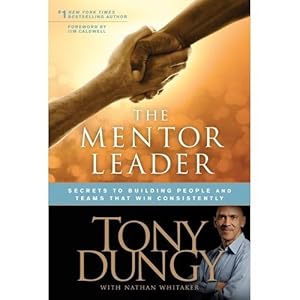
Review - The Mentor Leader

It's been a month filled with thinking, reading, and discussing the topic of mentoring (and I hope to share more on that soon). This, along with the fact that I'm now a Hoosier living in the state of Indiana, when coach Tony Dungy recently came out with a book called "The Mentor Leader", I had to order that and read it immediately! The full name of the book is "The Mentor Leader: Secrets to Building People and Teams that Win Consistently." Tony Dungy is, among other things, the football head coach who led the Indianapolis Colts to win the Super Bowl in 2007. What impressed me more about the fact of the win was the character of man behind the team. Dungy is a very devoted Christian whose faith is lived out in all aspects of his life, on and off the field. His book "Quiet Strength" was a NY Times best-seller.

The Mentor Leader is an excellent book that is both inspiring, challenging, and practical. Coach Dungy offers a truly unique perspective as a Super Bowl winning football coach, a devoted Christian, and a man who has benefited much mentoring and who has intentionally sought for years to have a positive influence on the lives of those he touches. The book is certainly not shy of principles and thoughtful teaching on the topics of mentoring in leadership, but it really shines as a practical and wise approach that has been borne in the laboratory of life rather than taught in a business school. He has seen firsthand "that the way to bring the best out of an individual or a team is to teach-by example and through one-on-one, step-by-step mentoring." The book is packed full of stories and anecdotes, but it is not just a random assortment of anecdotes. Dungy actually covers a lot of material, and arranges it thoughtfully.

Table of contents
Chapter 1. The Mandate of a Mentor Leader
Chapter 2. The Mind-Set of a Mentor Leader
Chapter 3. The Maturity of a Mentor Leader
Chapter 4. The Marks of a Mentor Leader
Chapter 5. The Moments of a Mentor Leader
Chapter 6. The Model of a Mentor Leader
Chapter 7. The Means of a Mentor Leader
Chapter 8. The Methods of a Mentor Leader
Chapter 9. The Measure of a Mentor Leader

If you're a fan of leadership books, you'll recognize ideas and quotes by leadership experts such as Ken Blanchard, Steven Covey, John Maxwell and others. If not, that's ok too, as he weaves these in naturally along with stories and real-life illustrations. Dungy also does a great job at pointing out where ideas like mentoring and servant leadership are taught and modeled in the Bible, especially in the life of Jesus Christ.

Some of the topics or concepts that I thought were particularly interesting: focusing on strengths, the preeminence of character and integrity in the live of a leader, building a team whose strengths complement yours and each others, the importance of just hanging out and being present in the lives of those you hope to influence, the need to create a culture to effect change, and the idea of treating those you lead as volunteers (and for some of us... they are!)  Now, there's nothing ground-breaking in any of this, but Dungy does a great job of modeling all of this, and of explaining it in a down-to-earth way.

Towards the end he finishes by acknowledging that a lot has been covered, and the idea of being a mentor leader might be a daunting one, a lot to remember. So he encourages us with the following...
"Don't worry about remembering it. Think instead about beginning to live what we've talked about - each and every day, in every setting of your life. And let me encourage you to start right where you are, with the people right around you, doing something as simple as engaging with them and talking. Sometimes the smallest things we do have the biggest impact. Just start."
Being a mentor leader is being about the journey, adding value in the lives of other people in every moment. It's recommended reading, for fans of leadership and football alike. You can find The Mentor Leader at Amazon or other retailers.

Tuesday, August 17, 2010

Summer is Coming to a Close

It might seem sometimes like I all do is read, given the number of reviews recently :)
Not quite true... so I thought I would just toss out some highlights of the summer before it winds down.

It's been a really good summer, although a bit warm and fairly quiet. I've been a homebody. Dawn and the kids did get to go on a bit of a roadtrip, to Virginia and Pennsylvania to hang out with family. Work has been quite good. The recession hasn't hurt us - in fact the current climate favors companies doing projects to cut costs and optimize their operations, so we've seen new business which has kept us nicely busy. I've played bass guitar in our praise team about every other week... kept up with volleyball (which I love), with the added addition of going to B-dubs afterwards most weeks. (Alas, that has not done well for weight control!) I've enjoyed relaxing with the kids, a mixture of Wii, hanging out in the hammack, a few visits to the pool, going out to Denny's, or watching a family movie together. Their in the final years before becoming teenagers, so I'm enjoying them while I can!

I've been doing a lot of reading about mentoring, and how to foster a mentoring culture. I've also been doing some reading on helping people discover and apply their strengths. That's a growing passion - to encourage and equip others to be all that God has called them to be. Summer has been a time to reflect on such things, and it provides a little extra time to just hang out and build relationships. Life can move so fast - friends have had a lot going on in their lives over the past several months too: friends who have moved away, or are planning to soon, some who have gotten married, others who are recently divorced.

So... sorry it's been a bit quiet around here. It's hard to find time to both build face-to-face relationships with people and do as much as I would like sharing thoughts on the blog. Right now I'm still feeling like I have so much to learn, not as much wisdom to share. Why is it so hard to 'find your voice?'  :)

Sunday, August 15, 2010

Review - The Jesus Manifesto

The "Jesus Manifesto: Restoring the Supremacy and Sovereignty of Christ" is a new book by Leonard Sweet and Frank Viola, by Thomas Nelson Publishers. I was initially hesitant about reading the Jesus Manifesto, simply because the main thesis of the book seems so obvious to evangelical Christians. Was there more to say about this that required more than a short booklet? I've enjoyed some other books by Leonard Sweet and enjoy his unique style of writing, so when I was able to get a free copy via Amazon's Vine program, I decided to see which reviews were closer to the truth - those that found it a wonderful and inspirational book, or those that found 'nothing new' here. (Honestly, both sides have a point.)

Sweet and Viola do indeed make a very strong case for a need to really put the focus on Christ - not His mission, not the Great Commission, neither on doing nor on being, but on Christ Himself. The book succeeds in getting far beyond the 'surface level' agreement most readers would find about the supremacy of Christ. The authors point out the subtle but important distinction between being person driven and purpose driven, between imitating Christ and having more of Christ living in us, and they point out the great mystery naturally inherent in truth. If you look inside the cover at the reviewers' praise comments, you'll see quite a diversity of pastors and theologians represented - including mainline churches, evangelicals, emerging, and missional leaders. That itself speaks well for the authors.

I also liked that the book pulled no punches. In several places I found myself saying "Amen!" while in others it was more of an "Ouch!" (like some comments unfavorable about another author I like, John Ortberg). The following concepts were particularly interesting, and worth getting and reading the book:
  • Lambasting the idea that there is something "deeper" we must graduate to become more mature. Instead, "Is there anything deeper than Christ?" Depth in Christ is our goal, not deeper teaching.
  • A wonderful and devotional look at Colossians, the supremacy of Christ and the incredible marvel of "Christ in you, the hope of glory."
  • The need to proclaim Christ, to teach the gospel, to both the lost and the found.
  • A caution about several popular trends today (like 'missional' thinking) that take a good thing but if not careful can exalt mission over Master
  • An extremely interesting and thought-provoking discussion of the question - 'Is developing Christlikeness a valid goal for disciples?' (Their answer might well surprise you!)
While I did find some parts obvious, and at one point wished the book were shorter, overall there really was a lot to think about and some very good points made in the Jesus Manifesto. I would recommend it for all Christian pastors and leaders. It is a necessary and lucid call for the church to soak in and preach the supremacy of Christ.

Monday, August 9, 2010

Review - Sticky Teams

"Sticky Teams: Keeping your Leadership Team and Staff on the Same Page" by Larry Osborne, is a book I received as part of a blog tour hosted by Engaging Church. They will be linking to reviews like these coming out this week.

Sticky Teams is not just about the importance of unity on a team, but really an excellent book about finding and keeping unity of purpose and vision among all the key components of a healthy church - the pastor and the church board, developing a unified staff, and how a pastor can promote the unity of the congregation. The principles in the book are of benefit to church staff members, ministry leaders, or those preparing for serving in ministry, but the target audience is really senior pastors. The reason is simple enough; you need the senior pastor leading the charge of developing this kind of unity among the church's leadership teams and congregation.

The book starts out making a strong case for unity - and the need to be very intentional in pursuing this. Part One focuses on landmines and roadblocks, and how things can easily go wrong with boards or with staff. It also talks about the double-edged sword of growth and what a game changer it is for the dynamics of leadership teams. Part Two is about getting everyone on the same page, with a practical focus on equipping others for ministry. Part Three is about communication, keeping everyone on the same page. The book concludes with a helpful set of discussion questions. The ideas and potential for discussion here are strong enough that our staff is starting to read this together. We'll also be discussing our "plumb-lines", the core values that guide how we do ministry and set priorities.

I enjoyed this book much more than Osborne's earlier book "Sticky Church" (which I thought overstressed the idea that sermon-based small groups are a key to unity in the church). Some of my favorite quotes and ideas from the "Sticky Teams" book:
  • "Jesus predicted growth but prayed for unity." (p21)
  • "Friends tend to give each other the benefit of the doubt, while strangers are cautious and suspicious. Friends debate. Strangers argue." (p31)
  • Very important to have right people on the bus, board and staff members who are actual leaders and not "representatives". (p51)
  • "Good" isn't good enough! If you can't find the best person, leave the spot open.
  • Six counter-intuitive principles of leadership (p73) 1. Ignore weaknesses, 2. Surveys are a waste of time, 3. Seek permission, not buy-in, 4. Let squeaky wheels squeak, 5. Let dying programs die, 6. Plan in pencil.
  • As a church grows, the role of the staff must change: shift from generalists to specialists; doing to empowering; "my" silo to "our" church (p108)
  • Make it special time not something tacked on: staff and board training should not be ten minutes carved out of a broader meeting, but something intentional and distinct. (p132)
  • For training leaders, the process and just getting people talking together is more important than the curriculum -- it's about dialoging and working through the implications of ideas and principles (p134)
If you're a pastor who is new in your position, tired of battling things out with the board, or hoping to prevent trouble with staff, "Sticky Teams" is a must-read. You can check out a sample chapter of Sticky Teams or buy the book at Amazon or other retailers.

Saturday, July 17, 2010

Review - Get a Life

Get a Life! Sometimes it's an insult, sometimes it's great advice. In this case, it's a book by Reggie McNeal - "Get a Life! It IS all about you." McNeal is an excellent writer, author of other powerful books such as The Present Future and Missional Renaissance. The goal of this book is to help you take a close look at yourself, to move beyond wishful thinking about your life into living a life of greater focus and meaning.

Clearly from the title of the book there is a strong self-help aspect to the book, and yet it is also a book about finding a much deeper relationship with God as you search for clues about how He designed you and what purposes He had in mind in crafting who you are. The book really centers around the following five questions that frame reflection on our lives:

1. Why am I here?
2. What is really important to me?
3. What is my scorecard?
4. What am I good at?
5. What do I need to learn?

Each question is the topic of a chapter, which talks about why the question is important and how you can arrive at solid answers. In addition there are a number of supporting questions raised in each chapter which would be very useful in a small group, or to write out the answers yourself. For example in the chapter 'What am I good at?' one series of questions include:
What do I do that causes me great pleasure?
When do I feel the smile of God?
What do I do that, when I do it, I say, "This is what I was born to do!"?
What talent(s) am I using in this activity?
What am I willing to order my life around so that I can do more of it?
McNeal really does a good job at asking these important questions without the book simply promoting self-actualization or narcissism. Reggie concludes with "You are a unique creation, a one-of-a-kind, a limited edition of one. God made you to show something about Himself to the world. To the extent you become fully you the world is made more complete."

Wednesday, July 14, 2010

How do we get it all done?

Last week over at the GoingToSeminary web site was a good article called "The Balancing Act". Nancy Wilson discussed the dangers of setting expectations too high, trying to hard in some area, and how easy it is for life to get out of balance. I continued the overall theme with an article posted at GoingToSeninary - called "Getting It All Done."

There I take a look at the example of Christ, and the verse John 17:4, exploring how Jesus managed to get done everything the Father expected of Him (not everything that all his friends and enemies expected of Him!) We're told that Jesus completed all the work the Father gave Him to do. How was He able to do this?
"When it came to getting things done, Jesus was a master of prioritizing at two different levels: strategic and operational. He got the big picture right – He knew why He was here, what His priorities were, and where He needed to invest most of His time. That meant for some very tough decisions. He focused on doing the will of the Father, on reaching the people of Israel, and on building deeply into the lives of only a handful of men. Everything He did reflected His top priorities. Equally importantly, he always seemed to get it right in-the-moment. He took time out for individuals, to heal people, to go to dinner parties with sinners. His sermons got to the point, His teaching time was focused, He never got bogged down arguing with His critics, and He balanced family and ministry perfectly."
Check it out --"Getting it All Done."

Monday, July 12, 2010

Review - AND blog tour

Today kicks off a blog tour for a new book by Hugh Halter and Matt Smay - "AND: The Gathered and Scattered Church." I was pleased to get a free review copy, as this book discusses an issue that is important to us at Calvary Baptist Church - what are the benefits of an attractional approach (draw people into the church to hear the gospel, find fellowship and build them up as disciples) versus a missional/incarnational approach (sending our people out into the lives of others directly to witness and grow as disciples). Pastor Chuck has maintained that it's Both-And; they're both useful. Yet if you listen to sermons or read 90-99% of books and blogs, they're diametrically opposed and you can't possibly do both well. Finally, a book that tries to bridge the gap and speak from a Both-And perspective??!

The introduction and first chapter talk about what the world needs from a church, and what God is doing through His church, how He and the church are 'beautifully sent' on mission. Chapter Two was for me the most powerful chapter in the book "Starting the AND... wherever you are". They jumped right in with discussion that target readers would need to know - how can you take a church that is strongly attractional, perhaps even inward focused, and help its people better understand what it means to live missionally and to see new avenues for ministry outside the walls of the church. It had some great discussion about how you can reach the same essential core of incarnational communities coming either from a gathered perspective or from a scattered perspective. Those coming from a gathered church might well consider a pilot group of about 10% of the church (a tithe of members) to receive training and support on developing incarnational communities.

One of the tough challenges in the book is really understanding what Halter means by the term 'Incarnational Community'. Is it a small group living missionally, a community ministry team, a home cell group, or something else? Is it something we've seen in a larger church, or something altogether different? I was somewhat disappointed to see this was not covered well in the book - rather the authors referenced their previous book, Tangible Kingdom, and a resource called the TK Primer for those who want to develop such communities. It makes sense from their perspective to do this and not waste time repeating material already available. Yet it is so central to their AND thesis that skimping here didn't help their cause. (It didn't help either that the Amazon reviews on Tangible Kingdom were downright scary, almost to the point of calling it heretical?!) After reading the book I saw an online article by Halter entitled What is incarnational community? which helps answer this key question.

Chapters 3 and 4 talk about something working against the church (consumerism) and something that done well is essential for the church (spiritual formation, but something broader than traditional spiritual disciplines).

Chapter 5 is where things started to go downhill fast for me, and I never saw a hoped-for recovery. Its goal was to discuss the tremendous harmony of gathered and scattered, but the authors get caught up in two scholarly terms coined by Ralph Winter - sodalic and modalic, how there is a need both for outreaching missionary activities and groups, and nurturing and support for those on the inside. Before this the books' style had been easy to read, stressing story and clarity. It's not that material was too hard to understand, but the stark contrast in style and approach were jarring.

Chapter 6 was one I looked forward to since getting excited in chapter two. It was called "Morph: Transitioning from Gathered to Gathered AND Scattered." It implicitly spoke as if you were the senior pastor of the church, and described the need to assess your gifting, calling, along with the capacity of your congregation. This was followed by a caution to be careful about the rate of change. And then... the chapter was over. Maybe this was a bad expectation on my part, I was sorely hoping this chapter was the one referenced on page 86: "In a later chapter we will unpack a process that every church can use that will move people from consumers to contributors, from fans to faithful followers, and from adherents to apprentices." I had been so pumped when I read that quote, yet after finishing chapter six it felt like they didn't come close to delivering on that promise.

Chapter 7 found me scratching my head completely. Had I misunderstood the whole aim of the book?? It was a discussion aimed at house churches and other missional communities committed to being scattered and incarnational, and discussed the question of if it was in any way useful to even gather at all in some kind of larger church service (!?) I started to reread the back cover and press info to find out if they were truly trying to propose a harmonious blend of mega-church style incarnational approaches and house-church style incarnational approaches, or were they trying to address the latter community and persuade them that it's ok to actually meet as a larger body without becoming a dead institution. The positive quotes on the back cover are from pioneers in the area of house churches and organic community; nothing said by mega-church pastors?

Chapter 8 tried to pull things together and encourage the reader to think about leaving a legacy, living as if you're really dying. It was inspirational but did not address the concerns developed in reading the previous three chapters.

I would have love to have seen more about the practical issues surrounding the tension between gathered and scattered - where does doctrinal instruction occur? is it really best for younger children and adults struggling with life issues and sin to sit together in the same group discussing the Bible? are teens hanging out with their folks at that time too? how are overseas missions to be supported? why wouldn't it be best to have a large audience being taught by a superbly gifted teacher? how does one learn how to face life-stage issues?

My conclusion after reading the book? No pun intended, but I can truly say that BOTH: I was highly disappointed with the book AND you should definitely read it if you have any kind of interest whatsoever in bridging the gap or resolving the tension between attractional/gathering and incarnational/scattering approaches to ministry, discipleship and evangelism. How can I say that? (Besides the fact that I may not be the target reader for the book?) Because I'm completely convinced, like I think Halter and Smay are, that both gathering as a large community and loving one another inside the family of God (modality), and living out our faith missionally in the lives of those around us far outside the walls of the church (sodality), are extremely important - and these together reflect the Great Commandment and the Great Commission - we cannot neglect either. The other reason it's important to read this book is because there isn't much out there that tries to bridge the gap. In addition, there is some really excellent material despite the flaws in the book. The book would still be worth getting if you only read the first two chapters. Finally, my disappointment may well be due to wrong expectations or high hopes going in to the book.

AND: The Gathered and Scattered Church is available at Amazon and other retailers.