As I've been reading several books on stewardship, finances, generosity, I kept seeing one book mentioned more than any other as the must-read book in this area. That book is "The Treasure Principle: Unlocking the Secret of Joyful Giving" by Randy Alcorn.
The back story of the author is quite powerful. After years of writing and teaching that "God owns everything" Randy Alcorn was sued by an abortion clinic (over a peaceful nonviolent protest). There was a multi-million dollar settlement that would garnish all wages beyond minimum wage. He had to resign as pastor and gave away all book royalties to missions and ministries. He and his family have been living out the message of The Treasure Principle - that "God really does own everything, takes care of us, and graciously puts assets into our hands that we might have the joy and privilege of investing in what will last for eternity."
This is a compact book that is easy to read. (Those wanting more depth can follow up with Alcorn's "Money, Possessions, and Eternity.") There are six chapters, and Randy skillfully describes the difference between investing for earthly gain versus investing for eternity, joyful giving, eternal rewards, roadblocks to giving, and getting started. Another welcome addition in the end is a 31 day prayer guide.
Alcorn states the Treasure Principle in a nutshell: "You can't take it with you - but you can send it on ahead." Then he shares six Treasure Principle Keys...
1. God owns everything. I'm His money manager.
2. My heart always goes where I put God's money.
3. Heaven, not earth, is my home.
4. I should live not for the dot but for the line. (life in heaven versus life on earth)
5. Giving is the only antidote to materialism.
6. God prospers me not to raise my standard of living, but to raise my standard of giving.
I enjoyed reading The Treasure Principle. It's highly biblical, relevant and educational, incorporating story and inspiration along the way. What's best is that the author is very passionate about this subject and is living out what he teaches. He even does a great job discussing tithing. "Tithing isn't the ceiling of giving; it's the floor. It's not the finish line of giving; it's just the starting blocks. Tithes can be the training wheels to launch us into the mind-set, skills, and habits of grace giving." There's a good reason this book is cited by so many others. Church leaders would do well to share a copy of this book with every member of their finance team, if not the whole congregation.
At the publisher's website you can view a video describing The Treasure Principle or read or download a sample chapter. It's on sale at Amazon and other retailers.
Disclosure of Material Connection: I received this book free from Waterbrook Multnomah Publishing Group for this review as part of their Blogging For Books Program. I was not required to write a positive review. The opinions I have expressed are my own. I am disclosing this in accordance with the Federal Trade Commission's 16 CFR, Part 255: "Guides Concerning the Use of Endorsements and Testimonials in Advertising".
Monday, March 28, 2011
Sunday, March 27, 2011
What are you reading?
It's been said that 5-10 years from now that we will be exactly the same person we are today, except for the books we read and the people we meet. That may be a bit of an exaggeration, but there's a lot of truth in there. Though I share a lot about books on this blog, I'm learning even more by serving and interacting with people. It's just easier to summarize a book than a person or what you learn from others :)
Reading anything interesting these days? Comment here and let me know!
I've just gotten a few orders from Amazon as I've been taking advantage of their sale of used books. Here is the latest batch in my pile of books to read...
Love Wins (Rob Bell)
Made to Crave (Lysa TerKeurst)
The Treasure Principle (Randy Alcorn)
The Chase (Jerry Bridges)
Revolution in Leadership (Reggie McNeal)
Called (Kary Oberbrunner)
Who Said Women Can't Teach? (Charles Trombrey)
Halftime (Bob Buford)
Why Gender Matters (Leonard Sax)
Simple Small Groups (Bill Search)
Peaceful Living in a Stressful World (Ronald Hutchcraft)
Mike the Most of Your Life (Kirk Nowery)
Revolutionary Generosity (Kirk Nowery)
Call Me If You Need Anything (Cathy Peterson)
How Full is Your Bucket (Rath and Clifton)
What else should I add to my list?
Saturday, March 26, 2011
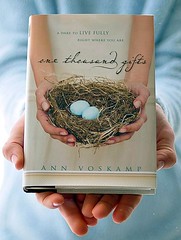
Review - One Thousand Gifts
"One Thousand Gifts: A Dare to Life Fully Right Where You Are" is a new book by Ann Voskamp, published by Zondervan in January 2011. Ann is a gifted and inspiring writer who hungers to live and share a live filled with grace - even amidst the pain, drama, and duties of life. One Thousand Gifts is a guide to living a life of joy. Ann discovered the tremendous benefit of living a life strongly characterized by thanksgiving. One Thousands gifts tells in part the story of putting together her list of 1000 blessings after confronting some very painful episodes of life. It's a challenging and inspirational book that may haunt, grip, or bless you. I feel somewhat bad that in the end I didn't enjoy the book that much.
Ann's style and perspective on life is unique. The book is as much poetry as it is story, mystical as much as educational. Ann portrays several difficult events and turns in her life with powerful authenticity. Her answer for all this... eucharisteo. No, I'm not trying to get academic on you; Ann describes this word early on and uses it constantly throughout the rest of the book. It's from Luke 22:19 "And he took bread, gave thanks and broke it, and gave it to them..." (NIV). Thanksgiving = eucharisteo in the original greek, related to charis (grace) and chara (joy). Ann learned how to forsake her discontent and ungrateful life for a lifestyle of thanksgiving. Thanksgiving in all things, an all times. The remainder of the book chronicles and explains this simple yet profound concept.
One Thousand Gifts has captivated many readers, becoming a NYT bestseller and top ten at Amazon. If you are feeling a lack of joy and recognize a lack of thankfulness in your own life, if you lean towards poetry and the mystical, chances are very good you will be touched by this book. On the other hand, if poetry leaves you scratching your head, or if you prefer reading something more expository, you may (like me) find it a struggle to make it through the book, skimming through the latter chapters after a few powerful opening chapters. With no disrespect for the skill of the author, I found the book rather hard to follow. (My bad; this engineering brain can be a curse.) For example, here is how Chapter Four begins...
Disclosure of Material Connection: I received this book free from Zondervan Publishers as a review copy. I was not required to write a positive review. The opinions I have expressed are my own. I am disclosing this in accordance with the Federal Trade Commission's 16 CFR, Part 255: "Guides Concerning the Use of Endorsements and Testimonials in Advertising".
Ann's style and perspective on life is unique. The book is as much poetry as it is story, mystical as much as educational. Ann portrays several difficult events and turns in her life with powerful authenticity. Her answer for all this... eucharisteo. No, I'm not trying to get academic on you; Ann describes this word early on and uses it constantly throughout the rest of the book. It's from Luke 22:19 "And he took bread, gave thanks and broke it, and gave it to them..." (NIV). Thanksgiving = eucharisteo in the original greek, related to charis (grace) and chara (joy). Ann learned how to forsake her discontent and ungrateful life for a lifestyle of thanksgiving. Thanksgiving in all things, an all times. The remainder of the book chronicles and explains this simple yet profound concept.
One Thousand Gifts has captivated many readers, becoming a NYT bestseller and top ten at Amazon. If you are feeling a lack of joy and recognize a lack of thankfulness in your own life, if you lean towards poetry and the mystical, chances are very good you will be touched by this book. On the other hand, if poetry leaves you scratching your head, or if you prefer reading something more expository, you may (like me) find it a struggle to make it through the book, skimming through the latter chapters after a few powerful opening chapters. With no disrespect for the skill of the author, I found the book rather hard to follow. (My bad; this engineering brain can be a curse.) For example, here is how Chapter Four begins...
"April sun pools into a dishwasher sink, liquid daylight on hands. The water is hot. I wash dishes. On my arms, just below the hiked sleeves, suds leave delicate water marks. Suds glisten. And over the soaking pots, the soap bubbles stack. This fragile tension arched in spheres of slick elastic sheets. Light impinges on slippery film." This moment leads to gift #362 which she records. A few pages later she relates this as 'my answer to time. Time is a relentless river. It rages on, a respecter of no one."One Thousand Gifts is available from Amazon and other book retailers. There is an excerpt available online that you might want to check out. Zondervan has also made available a free 19-pg reader's guide.
Disclosure of Material Connection: I received this book free from Zondervan Publishers as a review copy. I was not required to write a positive review. The opinions I have expressed are my own. I am disclosing this in accordance with the Federal Trade Commission's 16 CFR, Part 255: "Guides Concerning the Use of Endorsements and Testimonials in Advertising".
Wednesday, March 23, 2011
Living a Focused Life
This week I started my last class at Rockbridge Seminary, "Practicing the Focused Life." It's the capstone course which encourages students to reflect on where they've been and think about where they're going. The key concept of the course is that of a 'Focused Life.' Dr. Robert Clinton in "Strategic Concepts that Clarify a Focused Life" defines this as follows...
A focused life is
• a life dedicated to exclusively carrying out God's effective purposes through it,
• by identifying the focal issues, that is, the life purpose, effective methodology, major role, or ultimate contribution which allows
• an increasing prioritization of life's activities around the focal issues, and
• results in a satisfying life of being and doing.
Would you describe your life or ministry as focused? That would certainly be a stretch for me. But I sure like Clinton's description of what a focused life is all about. By God's grace, things have been coming more into focus, and my prayer is that over the next few months that God adds more clarity to how I can best serve Him according to the way He has designed me.
Are you developing, practicing, or longing for the focused life? Add a comment to let me know!
Monday, March 21, 2011
Parents - What are you modeling?
As parents we know how closely our kids are watching us, and seeing if what we say matches what we do. As a follower of Christ that can sometimes be scary. But how can we make that a good thing?
This morning, waiting for the school bus, my youngest son wandered in and asked what I was doing. Seeing the iPad in my hands, I have a feeling he wanted to know what game I was playing (and if he could have a turn). The simple answer would have been "Reading." What I said instead was "I'm reading the Bible. It's talking about how people see God in nature and events. I'm also praying. Is there anything you would like to pray about?" At this point I expected "No" or "That I have fun at school today." Instead, he asked if we could pray for those people hurt by the earthquake. Whoa. And so we did. And we prayed for mom who wasn't feeling well. And I added a prayer that he have a great day at school :)
Through this I saw two mistakes it's easy for us to make as parents. The first is misunderstanding the call for humility and not calling attention to praying (or fasting) and thinking that we should not be clear to our own children about what we are doing. My children don't see me studying the Bible or spending significant time in prayer after their bedtime or before they get up. There's a huge spiritual component to my life that is invisible to them. If I don't consciously model it or share it with them, how will they learn time with God is the source of my hope and strength?
The second problem is to underestimate our children (especially when they are younger). This leads us to oversimplifying a story or an answer to their question, or failing to talk to them about important things going on in the world around us. We had discussed the earthquake and tsunami in Japan at dinner earlier this week. His takeaway was more than 'weather is powerful'. It was also "The people of Japan are hurting. They need our prayers. They need our help. What can I do?"
So go ahead, let them see you reading the Word, praying, sneaking a kiss with mom. It would have been 'more productive' to wait five minutes until he was on the bus to dive into Romans. I'm glad I chose to jump in while his little eyes were looking.
Thursday, March 17, 2011
Review - Radical Together
I received an advanced reading copy of a new book to be released next month (April 19th) -- "Radical Together: Unleashing the People of God for the Purpose of God" by David Platt, published by WaterBrook Multnomah.
Radical Together is in some ways a sequel to Platt's best-selling book, "Radical: Taking Back Your Faith From the American Dream." Radical was an extremely challenging book, asking Christians to turn their backs on lukewarm consumeristic faith and embrace a more radical form of discipleship as Jesus expected from His followers (see my earlier review). Radical Together looks at this challenge to live as Jesus calls us to from a different perspective -- it's about an understanding of the church that embraces true disciples, how churches can help Christ followers live a more radical life. That doesn't mean it's just for pastors; Platt's audience is any Christian who desires to make a Kingdom impact. Whereas Radical looks at radical followers of Christ, Radical Together looks at radical communities of faith.
The Introduction lists the six main ideas around which the book is organized:
1. One of the worst enemies of Christians can be good things in the church.
2. The gospel that saves us from work saves us to work.
3. The Word does the work.
4. Building the right church depends on using all the wrong people.
5. We are living—and longing—for the end of the world.
6. We are selfless followers of a self-centered God.
Overall I enjoyed reading Radical Together (actually, more than the original Radical). It strongly challenges the church and asks a number of thought provoking questions ("What if the Bible is intended not only to dictate our theology but also to determine our methodology?") Chapter 4, The Genius of Wrong, was particularly interesting. It takes the premise that building the right church depends on using all the wrong people. Rather than use an attractional 'invite your friends' approach to evangelism, Brook Hills trains their people to share the gospel. "The reality is that the church will never make disciples according to God's full design until every person in the church sees this command as central for each of us, because his full design is that we all make disciples." No believer is to be on the sidelines of the Kingdom.
A discussion guide will be found in the end of the book (though not present in my pre-release copy). That's a great addition, as I can think of no better way to take in 'Radical Together' than by discussing it within a small group. A quote from the conclusion sums up the purpose of the book nicely: "How can we in the church best unleash the people of God in the Spirit of God with the Word of God for the glory of God in the world?"
You can find an excerpt and introduction at the WaterBrook Multnomah website, or you can download chapter one as a PDF. Radical Together will be released on April 19, 2011, on sale at Amazon, Christian Book Distributers and other retailers.
Disclosure of Material Connection: I received this book free from Waterbrook Multnomah Publishing Group for this review as part of their Blogging For Books Program. I was not required to write a positive review. The opinions I have expressed are my own. I am disclosing this in accordance with the Federal Trade Commission's 16 CFR, Part 255: "Guides Concerning the Use of Endorsements and Testimonials in Advertising".
Wednesday, March 16, 2011
Giving the Answer vs Giving a Chance to Learn
When someone comes to you with a question, or looking for advice, how do you respond? It's all to easy to simply give "the answer", telling them what you would do. But such a response may be missing a much bigger opportunity.
One improvement is to explain the 'why' behind the answer, sharing not only what you would do but why. This will help them evaluate the advice, and provides some insight as to what issues are important regarding the topic at hand.
But there's another approach that may be even better. Instead of telling them the answer (your answer), why not help them think through the question enough to come up with their own answer? Instead of giving them a fish, you're teaching them how to fish. How do we do this? Not by giving answers, but asking questions. 'What do you think?' 'Why?' 'What pitfalls could that run into?' 'Do you have the resources to do that?' 'What are the key issues at stake here?' 'What does Scripture have to say about this situation?' These coaching questions can be very powerful, and are great to use when developing the person you're talking to is more important (or as important) as the task or situation at hand. This not only improves the chance for a good solution, but helps people to think for themselves and understand underlying issues, and instills confidence.
Tuesday, March 15, 2011
Review - The Stewardship of Life
I wasn't sure what to expect when I got Kirk Nowery's book "The Stewardship of Life: Making the Most of All That You Have and All That You Are." I was looking to read something about stewardship that went beyond the money perspective, and saw a used copy of this book going for peanuts on Amazon. I'm very glad I did. The Stewardship of Life looks at a number of vital aspects of our life; it really expanded my view of what biblical stewardship entails.
The Stewardship of Vision
The Stewardship of Influence
The Stewardship of Commitment
The Stewardship of Time
The Stewardship of Opportunity
The Stewardship of Resources
The Stewardship of You
Nowery does an outstanding job of sharing insights and biblical principles on the many aspects of stewardship. Every opportunity that comes our way, every person in our sphere of influence, every hour we have, all our resources, our very lives - these are all gifts from God and we have the choice to make the most of all these, or to squander them. Much more than just abstract princples, Nowery shares several amazing stories and examples. What I didn't know was that Kirk Nowery is a colleague and friend of John Maxwell. He has also served as president of INJOY Stewardship Services, a company which has partnered with thousands of churches to raise more than two billion dollars for ministry projects. (But wait, there's more! He was also the chaplain of the Miami Dolphins, COO of Samaritan's Purse, and co-author of 33 Laws of Stewardship :)
I can highly recommend Stewardship of Life, not only for some great information, but because it's an inspirational book encouraging us to make the most of what we've been entrusted with as followers of Christ. It's not a new book (2004, Spire Resources), but one well worth checking out.
Monday, March 14, 2011
Secret of Contentment
My youngest son got a great big helium balloon yesterday. He was thrilled with it - an unexpected gift celebrating our Children's Ministry reaching their $5,000 goal to begin drilling a well to serve a community in Honduras. But his enthusiasm was short-lived.
He told his mom, "You know, I have to tell you I'm feeling a little bit jealous." 'Why is that?' "Well, I like my balloon, but my sister got a whole batch of like five balloons. So I don't feel so good about my one balloon."
I called him over and shared I've felt that way before, and I was proud of him for verbalizing his feelings so well. But then I reminded him that his balloon was awesome regardless of what his sister had, and that the children in the village who would be getting a well have never seen a balloon. Not one, much less a big helium one. They drink water that isn't as clean as what we have in our toilet. The point - if we compare what we have to what other people have, we're setting ourselves up for disappointment. We need to be thankful for what we do have, regardless of what we wish we had.
Great timing, as this was exactly the message in our sermon and Children's ministry yesterday. The apostle Paul shares "I know what it is to be in need, and I know what it is to have plenty. I have learned the secret of being content in any and every situation, whether well fed or hungry, whether living in plenty or in want." (Philippians 4:11-12, NIV) Paul's secret for contentment? A spirit of thankfulness, an attitude of rejoicing, in all that we have and are in Christ.
It's easy to think it childish when one of your kids wants five balloons instead of one. But parents, don't we fail to find contentment when we are disgruntled about our house, our old car, our job or co-workers, or spouse? If you're feeling that way, admit it to God, and reflect on the many things you are thankful for.
Saturday, March 12, 2011
Review - Share the Well
Share the Well is a gem of a book - a wonderful collection of stories, inspiration of a movement of God's people, and some stunning and unique photos that speak as richly as the words in the book. It has the look of a coffee table book (and a good one at that), but it's much more. The story of Share the Well is not one story, but many intertwined. It is the story of a passionate and loving family who, simply put, want to change the world. It's the story of a people who are receiving and sharing the Living Water of Jesus with a people who need to know God loves them. It's the story of pastors and missionaries who are laying it all out there. Most of all it's the story of a movement, not just of churches planted, but a growing network of people committed to living out the Great Commission - in the great country of India and around the globe.
Share the Well is a new book, written by Rob and Michelle Wegner of Granger Community Church. The Wegner's story sprang out of reading the Gospels and the book of Acts and yearning deeply, "I want to give my life to a movement like that." In Share the Well, we see that they have :) The approach in this movement is not simply to plant churches, but to train leaders, to instill purpose, to develop pastors and leaders to be capable trainers themselves, and to go beyond all this and train people about community development. 'All too often we are giving young people cut flowers when we should be teaching them to grow their own plants.' This quote (by John Gardner) sheds some light on their approach both on meeting physical needs and on seeing exponential church growth occur through leadership development. All those involved are in for the long haul, and they're making a difference.
As one who spent a year in India myself, I can echo the comments of other reviewers that this book will stir your emotions and bring back memories of a wonderful people. Whether your interest in the book is out of a love for India, and appreciation for stunning photography, or a love of simple yet rich stories that bring honor to God, you're going to love Share the Well.
(While I've not met Rob and Michelle personally, I feel like friends as I've prayed for their family and ministry for a while now, and we share a love of India and sharing the good news there. Rob is the Pastor of Life Mission at GCC and blogs at Entermission; his wife Michelle has a great blog Living on Purpose - check 'em out.)
Subscribe to:
Posts (Atom)


